
Compact Recovery Gear for 4Runner: A 2026 Guide

Table of Contents
- Why 4Runner Owners Need Space-Saving Recovery Gear
- Soft Shackle vs Steel Shackle: Which Fits Your Rig?
- Kinetic Ropes and Snatch Straps for Compact Storage
- How to Use Recovery Boards Without Wasting Cargo Space
- Air Compressors, Deflators, and Mounting Solutions
- The Off-Road Recovery Gear Checklist for 5th Gen 4Runners
- Real-World Failure Scenarios and Gear Maintenance
- Build Your Compact Recovery Kit
- Frequently Asked Questions
Why 4Runner Owners Need Space-Saving Recovery Gear
The 5th Gen 4Runner is capable, but its cargo area fills up fast with a fridge, tools, and camping gear. Compact recovery gear is about carrying self-recovery capability without sacrificing the space your family and expedition gear need. Every item must earn its place through function and footprint.
Traditional kits are bulky, often packed in rigid bags that waste space. A common fix is to ditch the hard case and build a soft-sided kit that conforms to unused voids.
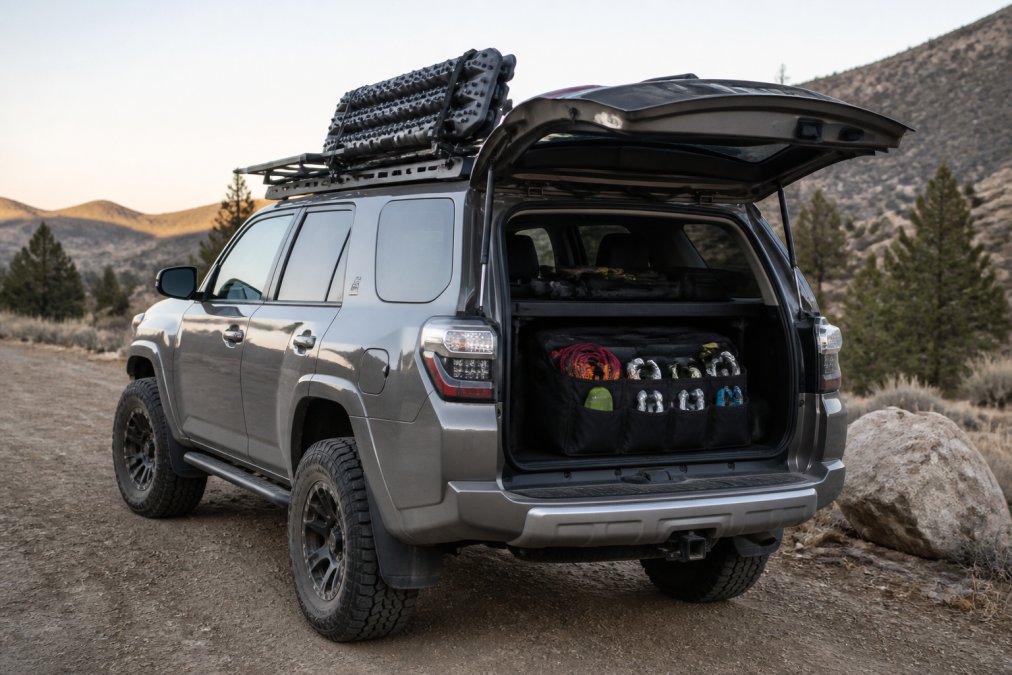
Gear that works but does not fit is useless if it is buried under a week of supplies when you are stuck. A modular setup lets you reach the snatch strap or deflator without unpacking the entire vehicle.
Soft Shackle vs Steel Shackle: Which Fits Your Rig?
Soft shackles are the superior choice for most 4Runner owners because they are lighter, safer, and store flat. A steel D-ring shackle is heavy and can become a dangerous projectile if a line snaps. Soft shackles, made from high-strength synthetic fiber, weigh ounces rather than pounds and can be coiled into a space no larger than a water bottle.
When a steel shackle breaks under load, it releases immense kinetic energy violently. Synthetic soft shackles have a higher breaking strength relative to weight and fail more gracefully. For a 4,400 to 4,800-pound vehicle, you need recovery points rated for at least 2.5 times the vehicle weight (arb.com.au).
| Feature | Soft Shackle | Steel D-Ring Shackle |
|---|---|---|
| Weight | Ounces, stores flat | Pounds, bulky |
| Failure Mode | Snaps with less recoil | High-velocity projectile risk |
| Load Rating | High breaking strength | High working load limit |
| Storage | Coils into small gaps | Requires rigid mount |
| Best For | Compact 4Runner kits | Heavy-duty rigs with storage |
A common mistake is using a soft shackle on a factory tie-down loop, which is often only rated for securing cargo, not dynamic recovery. Use rated tow points bolted to the frame, and connect soft shackles with a thimble to prevent abrasion against sharp edges.
Kinetic Ropes and Snatch Straps for Compact Storage
Kinetic energy ropes store and release energy to yank a vehicle free; snatch straps offer a similar benefit with less stretch. A 30-foot kinetic rope coils down to roughly the size of a large dinner plate, far easier to stow than a chain or wire cable.
Check the rope's breaking strength versus vehicle weight: too high and it will not stretch, too low and it can snap. Most compact kits for mid-size SUVs feature ropes rated between 30,000 and 40,000 pounds. Pair the rope with a dampener draped over the line mid-span during the pull.
How to Use Recovery Boards Without Wasting Cargo Space
Recovery boards are essential for sand, mud, and snow self-recovery, but full-size boards are often 48 inches long and do not fit easily inside. Mount them vertically against the rear window or flat on a roof rack.
Roof-rack mounting keeps boards out of the cabin but adds high weight that affects handling. Inside, use a bracket to secure them to a drawer system or the cargo floor. To use them, dig out the tires, place the boards in front of the drive wheels, and maintain steady throttle, do not spin the tires aggressively.
Air Compressors, Deflators, and Mounting Solutions
Air compressors are the heaviest single item in a recovery kit but are non-negotiable for airing down tires. The trade-off is a portable 12V unit in a cubby versus a permanent under-hood mount that frees cargo space entirely. Most owners start portable, but the permanent mount is the better long-term solution.
Portable compressors like the Viair 88P or ARB CKMP12 fit in the rear quarter-panel cubby or under the second-row seat. Most are rated for intermittent use, 30 minutes on, 30 minutes off, which is fine for airing up four tires from 18 to 35 PSI. A unit with a hard case weighs 10 to 15 pounds and takes up roughly 1.5 cubic feet; ditching the case for a soft pouch reclaims half that volume.
Under-hood mounts are the space-saving gold standard. A twin-cylinder compressor like the ARB CKMA12 or Morrflate 4-Tire kit mounts to the inner fender or firewall, removing weight and bulk from the cargo area. The trade-off is installation: run 10-gauge or heavier power wire, install a relay and inline fuse rated for 50 to 60 amps, and route an air line to a quick-disconnect near the rear bumper. Most owners report a 2 to 3 hour install.
Precision deflators like the ARB E-Z Deflator or Staun screw onto the valve stem and stop at a preset pressure, such as 18 PSI. They weigh less than 4 ounces each and store in a small pouch. The alternative, a digital gauge and manual bleeding, is lighter but slower and less accurate.
A 4-tire hose kit connects all four tires to the compressor simultaneously, cutting air-up time from roughly 15 minutes to 5 minutes. It coils into a 6-inch loop and weighs under 2 pounds, offering one of the best weight-to-convenience ratios in any recovery kit.
For most owners, the optimal compact setup is a permanent under-hood compressor with deflators and a 4-tire hose kit. This removes the heaviest item from the cargo area, keeps the air system ready, and adds only about 3 pounds of permanent weight. If you are not ready for the wiring project, a portable unit in a soft pouch is an acceptable compromise.
The Off-Road Recovery Gear Checklist for 5th Gen 4Runners
Building a compact recovery kit requires a checklist that prioritizes items by frequency of use and safety impact. Start with the essentials that address the most common stuck scenarios: soft shackles, a kinetic rope, and recovery boards. Add a shovel and a tire pressure gauge for basic trail readiness.
- Soft shackles (2-3, rated for your vehicle weight)
- Kinetic energy rope (30 ft, rated for 4Runner weight)
- Recovery boards (pair, with mounting solution)
- Portable air compressor and tire deflators
- Rated tow points (front and rear)
- Winch damper or heavy blanket
- Work gloves and a folding shovel
A snatch block doubles a winch's pulling power and allows directional pulls. If you run a winch, a synthetic line is safer and lighter than steel cable. A tree trunk protector prevents damage when using trees as anchor points. These items add weight, so evaluate whether you carry a winch before adding rigging gear.
Real-World Failure Scenarios and Gear Maintenance
Most recovery gear failures trace back to poor maintenance or incorrect technique. A kinetic rope that snaps can send a metal shackle through a rear window or injure a spotter. Understanding how gear degrades, and how to inspect it, is as important as knowing how to use it.
Synthetic rope and soft shackle failure modes. UV exposure is the primary enemy of nylon and Dyneema. A kinetic rope stored on a roof rack in direct sunlight for six months can lose 30 to 50 percent of its breaking strength (samsonrope.com). Soft shackles abrade against grit or chafe against sharp edges; a shackle that looks fine outside can have internal damage that halves its rating.
Inspection protocol before every trip. Run your fingers along every synthetic rope and soft shackle. Soft spots indicate internal fiber breakage; hard spots or fused fibers mean heat damage. Any of these findings means the gear should be retired. For steel hardware, check for bent pins, cracked welds, or corrosion, a bent D-ring pin is a catastrophic failure waiting to happen.
The static strap mistake. Using a static tow strap for a dynamic yank is a common error. A static strap has minimal stretch, 2 to 3 percent, so the shock load can exceed its breaking strength or transfer directly to frame mounts (bubbarope.com). A kinetic rope stretches 20 to 30 percent and releases energy gradually. If you only carry one strap, make it a kinetic rope.
Post-recovery maintenance. Mud and salt water are the most corrosive environments for recovery gear. Rinse all synthetic gear with fresh water immediately after use in these conditions. Wash with mild soap and water, then dry completely out of direct sunlight. Do not machine wash or dry. For steel shackles and mounts, wipe down and apply a light coat of corrosion inhibitor to threads and pins.
Storage best practices. Store synthetic gear in a breathable bag, not an airtight container, as trapped moisture promotes mildew. Coil kinetic ropes loosely, tight coils create kinks that become stress points. Store soft shackles unloaded. A canvas or Cordura bag with a desiccant pack is sufficient for most climates.
Experienced overlanders replace all synthetic recovery gear every three to five years, regardless of visible wear. The cost of replacement is small compared to a broken window, damaged frame mount, or injury. If you cannot remember when you bought your gear, it is time to replace it.
Build Your Compact Recovery Kit
Assembling your compact recovery gear is about balancing capability with the vehicle's physical constraints. The gear is only valuable if you know how to use it and where it lives. Practice attaching soft shackles to your rated recovery points in your driveway before you head out.
At OverlandRetail.com, we curate recovery kits and components that prioritize durability and compact design. Our products are built to withstand the demands of the road less traveled, from precision tire deflators to recovery boards and mounting accessories. We offer free shipping and returns so you can build your kit with confidence, knowing that the gear you carry is field-tested for the trail.
Frequently Asked Questions
How do I store recovery gear in a 4Runner without losing cargo space?
Use a flat recovery gear bag that slides under the rear seat or behind the third-row storage bin. Mount traction boards vertically against the cargo wall or on a roof rack. Choose a compact air compressor that fits in the side cubby. Rolling soft shackles and kinetic ropes instead of folding them keeps them flexible and reduces the space they take up.
What is the difference between soft shackles and steel shackles for recovery?
Soft shackles weigh about 90% less than steel D-ring shackles and store flat, which helps for compact recovery gear for 4Runner builds. They have a similar working load limit when rated properly, but soft shackles are safer if they break because they do not become a projectile. Steel shackles resist abrasion better, so they work well when dragging over rocks.
Do I need a winch if I have compact recovery gear?
No. A winch adds roughly 60-80 lbs to the front of your 4Runner and requires a heavy-duty bumper or mounting plate. Kinetic ropes, recovery boards, and a come-along handle most self-recovery situations on trails. A winch becomes necessary only for deep mud, steep inclines, or solo travel in remote areas where no anchor vehicle is available.
What are the best recovery boards for limited storage space?
Look for boards in the 36-inch range rather than 44-inch models. Stackable designs with interlocking teeth store flatter against the cargo wall. Some brands offer soft-sided carry bags that compress the boards together. Pair them with a roof rack mount if you need the cargo floor completely clear for camping gear or a sleeping platform.
Recovery gear is the difference between a minor inconvenience and a stranded vehicle miles from help. Build a kit that fits your 4Runner's space constraints, and you will travel further with confidence. Get started with OverlandRetail.com and equip your rig with durable, space-saving recovery gear designed for real expeditions.