
Essential 4x4 Vehicle Recovery Tools (2026 Guide)

Table of Contents
- Why Your 4x4 Recovery Tools Can Make or Break a Trip
- Kinetic Rope vs Tow Strap: Which One Belongs in Your Kit
- How to Use Recovery Boards to Get Unstuck Fast
- Winches, Soft Shackles, and Rigging Gear Explained
- Tire Pressure Management, Hi-Lift Jacks, and PPE
- Off-Road Recovery Kit Checklist: Budget vs Professional Grade
- The Complete 4x4 Vehicle Recovery Tools Buying Decision
- Frequently Asked Questions
Last Updated: September 2, 2026
Every year, off-road enthusiasts head into remote terrain with capable vehicles but inadequate recovery kits. This guide covers the essential 4x4 vehicle recovery tools every serious overlander needs, with guidance on what each tool does, when to use it, and how to choose between budget and professional-grade options.
A recovery kit isn't a shopping list. It's a system. The tools only work when matched to your vehicle, terrain, and skill level.
Why Your 4x4 Recovery Tools Can Make or Break a Trip
The difference between a minor delay and a dangerous situation often comes down to what's in your recovery kit. Recovery gear serves completely different functions: kinetic ropes, static straps, traction boards, winches, and soft shackles are not interchangeable. Using a static tow strap where a kinetic rope is needed doesn't just fail, it can break recovery points, damage both vehicles, or cause injury.
Recovery points matter as much as the gear itself. Attaching a kinetic rope to a tow ball is one of the most common mistakes in off-road recovery and is responsible for serious accidents every season. According to the Tread Lightly! organization's trail safety guidelines, proper rigging technique and knowing your vehicle's rated recovery points are foundational to safe off-road recovery.
Kinetic Rope vs Tow Strap: Which One Belongs in Your Kit
A kinetic energy rope is engineered to stretch 20-30% under load, storing energy like a spring and releasing it to pull a stuck vehicle free. The stretch absorbs shock, reduces peak forces on both vehicles, and allows a moving recovery vehicle to build momentum before the rope goes taut. This is the tool for serious recoveries where a vehicle is deeply embedded in mud, sand, or snow.
A static tow strap, like the Rhino USA Ultimate Recovery Tow Strap, is a non-stretching strap designed for steady, controlled pulls. It's the right choice when the stuck vehicle needs light assistance on stable ground. The Rhino USA strap uses poly-silk blend construction with reinforced eyelets and break strengths up to 48,000 lbs.
How Kinetic Energy Ropes Work
A kinetic rope converts the recovery vehicle's momentum into stored elastic energy. As the rope stretches, it absorbs the shock load that would otherwise transfer directly to both vehicles' frames. When the rope reaches maximum extension, it rebounds, adding its stored energy to the pull. This allows a recovery vehicle moving at 5-15 mph to generate far more extraction force than a static pull, often the only technique that works for deep bog recoveries.
When a Static Tow Strap Is the Right Call
Static straps excel in low-intensity situations: a vehicle lightly beached on a rock, slightly off-camber, or stuck in shallow mud where a firm, steady pull is sufficient. Never attach either strap to a tow ball, trailer hitch receiver, or any non-rated recovery point. Always use rated D-rings or soft shackles attached to manufacturer-designated recovery points.
How to Use Recovery Boards to Get Unstuck Fast
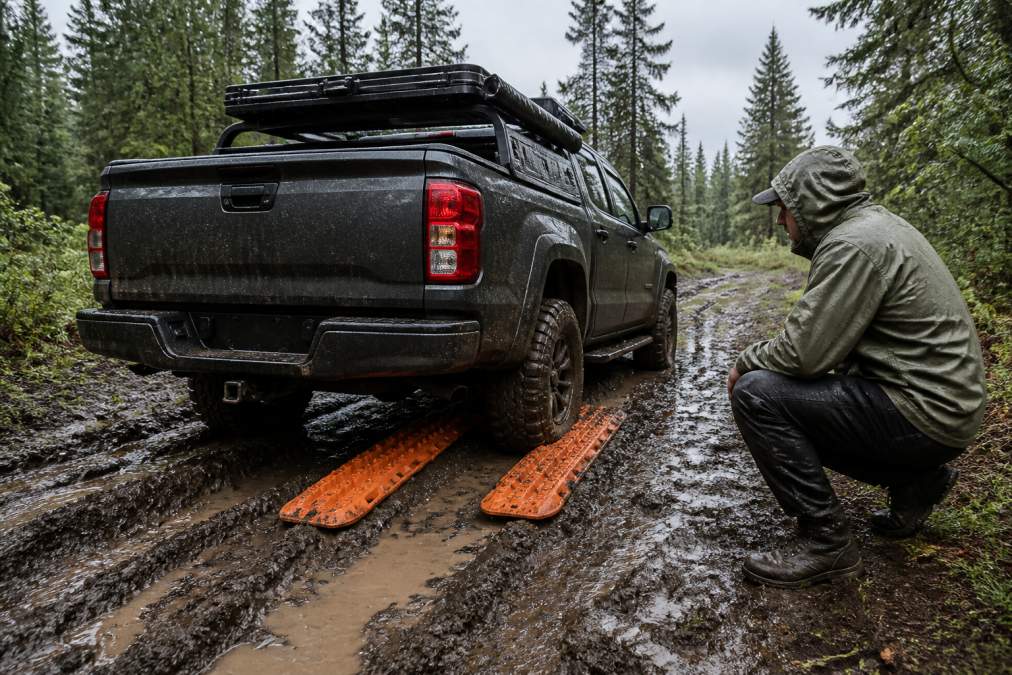
Recovery boards are the most beginner-friendly essential 4x4 vehicle recovery tool. When tires are spinning with no traction, boards give them something to bite into, allowing the vehicle to drive itself out without needing a second vehicle.
Step-by-Step Deployment in Sand, Mud, and Snow
- Stop spinning the tires immediately. Continued spinning digs the vehicle deeper.
- Clear loose material from in front of the drive wheels using a shovel or the integrated shovel end built into boards like the MAXTRAX MKII.
- Slide the boards under the drive wheels, cleats facing up, positioned so the tires sit in the board's channels.
- Deflate tires slightly; lower pressure increases the contact patch and helps the boards work more effectively.
- Apply gentle, steady throttle. Let the cleats grip and the vehicle walk itself forward.
MAXTRAX MKII vs ARB TRED Pro: What to Know
The MAXTRAX MKII uses UV-stabilized, fiber-reinforced engineering-grade nylon with a patented Keyhole cleat system. At 7.5 lbs per board, it's light enough that deployment isn't a chore, and the integrated shovel ends are genuinely useful in sand.
The ARB TRED Pro uses EXOTRED composite construction with SIPE-LOCK grip profiles designed to engage directly with tire sipes. Both are significantly better than budget boards that crack under load.
Winches, Soft Shackles, and Rigging Gear Explained
Winching is the most technically demanding part of off-road recovery, and it's where gear failures cause the most serious injuries.
Choosing a Winch: Synthetic Line and Fairlead Basics
Size your winch at 1.5 times your vehicle's gross vehicle weight rating. A 6,000 lb vehicle needs at minimum a 9,000 lb winch.
Synthetic winch line has replaced steel cable as the standard. It's lighter, safer when it breaks (it drops rather than recoiling), floats in water, and is easier to handle with gloves. The Smittybilt XRC Gen3 9.5K comes with 95 feet of synthetic rope and an aluminum hawse fairlead, with IP67 waterproof rating and a remote controller with load indicator warning system. For top-tier durability, the WARN ZEON 10-S offers IP68 waterproofing, 100 feet of Spydura synthetic rope, and is designed, engineered, and assembled in the USA.
Hawse fairleads are designed for synthetic rope; roller fairleads work with steel cable.
Soft Shackles, Snatch Blocks, and Tree Trunk Protectors
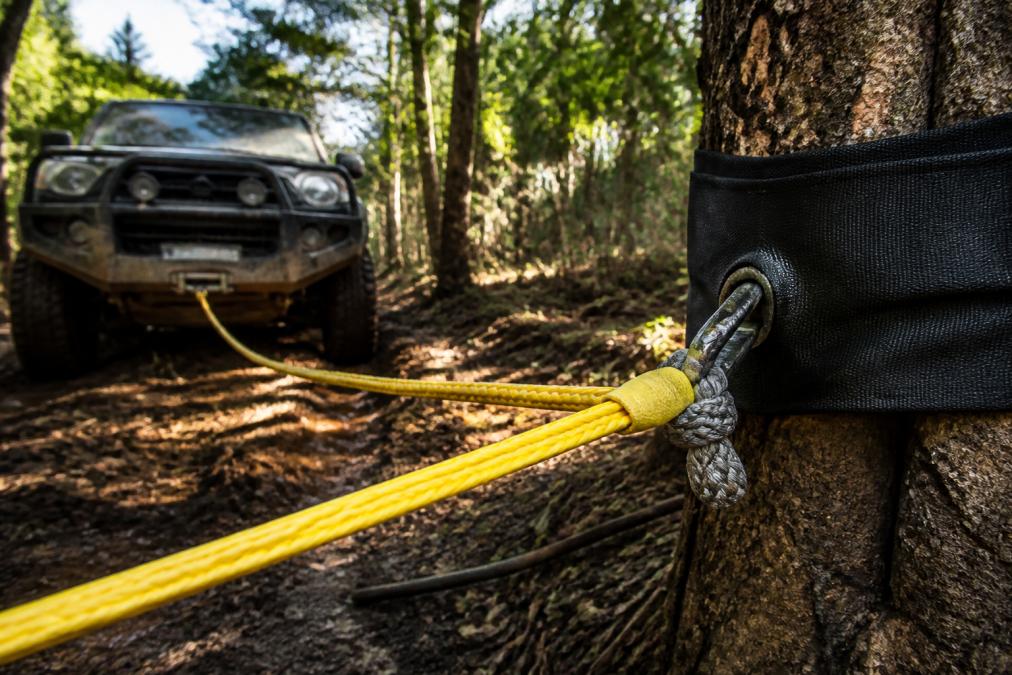
A soft shackle is a looped synthetic rope connector that replaces traditional steel D-rings. The Bubba Rope Gator-Jaw soft shackle, made from Plasma UHMPE rope, has breaking strengths ranging from 52,300 to 76,400 lbs depending on size. If it fails, it drops rather than becoming a projectile.
A snatch block is a pulley that redirects your winch line and doubles your pulling capacity in a double-line pull. Every serious recovery kit needs at least one.
A tree trunk protector is a wide nylon strap that wraps around a tree to create an anchor point without damaging bark.
Recovery Point Identification and Vehicle Limits
Every vehicle has manufacturer-designated recovery points, typically integrated into the frame or bumper. Check your vehicle's owner manual for rated recovery point locations and working load limits. Exceeding those limits risks pulling the point free from the frame.
Tire Pressure Management, Hi-Lift Jacks, and PPE
Tire pressure management is the most overlooked element of off-road preparedness and often the difference between needing a recovery and not.
Tire Deflators and Air Compressors
Airing down dramatically improves traction on sand, mud, and loose terrain by increasing the tire's contact patch. A tire aired down from 35 PSI to 15 PSI in sand can float over terrain that would bury a fully inflated tire.
The VIAIR 400P Portable Air Compressor inflates tires up to 35 inches from 0 to 30 PSI in under 6 minutes, running off a 12-volt battery connection, with 150 PSI maximum working pressure. According to the Tire Industry Association's tire safety guidelines, maintaining correct tire pressure for the terrain type is a primary factor in off-road vehicle control and recovery prevention.
Hi-Lift Jacks and Recovery Gloves
The Hi-Lift X-TREME Jack has a 4,660 lb rated capacity and functions as a jack, winch, clamp, and spreader. Available in 48-inch and 60-inch heights, it handles situations where a standard floor jack would be useless.
Recovery gloves are non-negotiable PPE. Synthetic winch lines and recovery straps can develop fraying that causes serious lacerations.
Off-Road Recovery Kit Checklist: Budget vs Professional Grade
Building a recovery kit is a tiered process. Start with essentials and add capability as your terrain demands it.
| Item | Budget Option | Professional Grade | Priority |
|---|---|---|---|
| Kinetic rope | Basic nylon kinetic rope | Rated UHMPE kinetic rope | Essential |
| Static strap | Rhino USA tow strap | Heavy-duty rated strap | Essential |
| Recovery boards | Entry-level plastic boards | MAXTRAX MKII or ARB TRED Pro | Essential |
| Soft shackles | Single soft shackle | Bubba Rope Gator-Jaw set | Essential |
| Snatch block | Single pulley block | Rated double-pulley block | Essential |
| Tree trunk protector | 3-inch nylon strap | 4-inch rated protector | Essential |
| Winch | Entry-level 9,500 lb winch | Smittybilt XRC Gen3 or WARN ZEON | Highly recommended |
| Air management | Basic deflator + compressor | Precision deflators + VIAIR 400P | Essential |
| Hi-Lift jack | Standard Hi-Lift | Hi-Lift X-TREME | Recommended |
| Recovery gloves | Basic leather gloves | Cut-resistant recovery gloves | Essential |
Gear Maintenance, Inspection, and Tread Lightly Principles
Recovery gear maintenance is where gear failures originate. A kinetic rope stored wet degrades faster. A soft shackle with a single cut in the fibers can fail catastrophically under load. A winch that hasn't been spooled out and re-tensioned in a season may have dead wraps that reduce its pulling capacity.
Inspection protocol before every trip:
- Check kinetic ropes and tow straps for fraying, cuts, UV degradation, and stiff sections
- Inspect soft shackles for fiber damage, cuts, or compression damage at the loops
- Spool out the winch line fully, check for kinks, fraying, and proper tension on re-spool
- Verify all D-rings and shackle pins are fully tightened and moused
- Test winch operation in both directions before leaving the trailhead
- Check recovery board cleats for cracking or missing sections
The Tread Lightly! principles for off-road travel emphasize staying on designated trails, using existing anchor points where possible, and avoiding tree trunk protectors around trees with damaged bark. For gear that sits between you and a dangerous situation, professional-grade construction isn't a luxury, it's the point.
The Complete 4x4 Vehicle Recovery Tools Buying Decision
The essential 4x4 vehicle recovery tools decision comes down to three variables: your vehicle's weight and recovery point ratings, your typical terrain, and whether you travel solo or with a group.
Solo overlanders need more self-recovery capability: a winch, recovery boards, and a Hi-Lift jack cover most scenarios without needing a second vehicle. Vehicle weight determines winch and strap ratings. Terrain drives board selection: deep sand and loose mud favor kinetic rope recoveries and boards with aggressive cleats, while rocky terrain favors a Hi-Lift jack and winch.
Essential 4x4 vehicle recovery tools should be sourced from brands with independently tested ratings and real warranties. OverlandRetail.com curates gear meeting this standard, with free shipping and returns so you can verify fit and quality before your first expedition. For rigging techniques and safe winching practices, the Society of Automotive Engineers off-road recovery technical resources provides engineering-level documentation on load ratings and recovery system design.
The bottom line: buy rated gear, learn the techniques before you need them, and inspect everything before every trip.
Off-road recovery failures rarely happen because someone bought the wrong brand. They happen because someone skipped the training, ignored gear inspection, or attached a strap to a non-rated point. OverlandRetail.com's curated selection of recovery gear, including precision tire deflators, kinetic ropes, recovery boards, and winch accessories, is built for getting you out when things go sideways and helping you avoid getting stuck in the first place. Browse the full recovery kit range at OverlandRetail.com and get equipped before your next expedition.
Frequently Asked Questions
Q: What is the difference between a kinetic rope and a tow strap?
A: A kinetic energy rope stretches 20-30% under load, storing energy like a spring and releasing it to jerk a stuck vehicle free without a running start. A static tow strap has little to no stretch, transferring pull force directly from one vehicle to another. Kinetic ropes excel in deep mud and sand where momentum matters. Static straps work better for slow, controlled extractions on firm ground. Both have rated breaking strengths and working load limits you should always check before use.
Q: Do I need a winch for basic off-road recovery?
A: Not necessarily. A solid pair of traction boards, a kinetic recovery rope, and soft shackles handle the majority of trail recoveries without a winch. A winch becomes essential for solo overlanding, technical terrain with no recovery vehicle nearby, or situations where another vehicle cannot get close enough to pull. If your budget allows only one major purchase, start with a quality recovery rope and traction boards, then add a winch as your trails get more demanding.
Q: How do I maintain my off-road recovery equipment?
A: Inspect every piece of gear before each trip. Check synthetic winch lines and kinetic ropes for fraying, kinks, or UV damage. Look at soft shackles for cuts, abrasion, or discoloration. Rinse mud and sand off traction boards after use and check cleats for cracks. Store straps and ropes loosely coiled in a dry bag away from direct sunlight. Replace any item that shows structural damage immediately. A compromised recovery strap or shackle can fail at the worst possible moment.
Q: What safety gear is required for vehicle extraction?
A: Recovery gloves are non-negotiable when handling winch lines, shackles, or snatch blocks. A safety damper, placed over the winch line during a pull, absorbs energy if a connection fails and prevents the line from snapping back. Keep bystanders at least 1.5 times the rope length away from the recovery zone. Identify rated recovery points on both vehicles before attaching anything. Never attach a recovery strap to a trailer hitch ball; use a proper D-ring or recovery point rated for the load.
Q: What is the best starting recovery kit for a smaller 4x4 like a Toyota 4Runner?
A: A compact kit for a mid-size 4x4 should include: one kinetic recovery rope sized to at least 2x your vehicle's weight rating, two soft shackles, a pair of traction boards, a tree trunk protector, a snatch block, recovery gloves, and a safety damper. Add a quality tire deflator and portable air compressor to manage tire pressure on trail. This kit covers the majority of self-recovery and assisted recovery scenarios without excessive weight or bulk for a smaller platform.