
Offroad Recovery Gear Safety Tips for 4x4 Drivers

Table of Contents
- Before You Pull: Assess the Situation and Gear Up
- The Best 4x4 Recovery Kit Essentials for Safety
- Kinetic Recovery Rope Safety: Snatch Straps vs. Tow Straps
- Off-Road Winch Safety Tips: Rigging and Technique
- Anchor Points, Dampeners, and Communication Protocols
- Post-Recovery Gear Maintenance and Trail Etiquette
- Build Your Recovery Skills and Kit with Confidence
- Frequently Asked Questions
Last Updated: September 5, 2026
Getting stuck is part of off-roading. Getting out safely is a skill that separates experienced drivers from those who turn a minor mistake into a damaged vehicle, snapped equipment, or a serious injury. Offroad recovery gear safety tips are about understanding how kinetic energy, load limits, and human error interact when your rig is buried to the frame. This guide breaks down the essential equipment, the correct techniques, and the mental discipline required to perform a recovery that gets you moving again without anyone getting hurt.
The first rule of vehicle recovery is that it is a controlled use of force, not a test of strength. Every piece of gear you carry has a breaking point, and every recovery scenario has a safe way to proceed.
Before You Pull: Assess the Situation and Gear Up
A safe recovery begins before you attach a single strap. Walk around the stuck vehicle and evaluate the terrain, the angle of the pull, and the condition of the ground. Determine if you are performing a self-recovery or using a second vehicle, and identify which direction offers the safest, most stable path out.
You must also verify the recovery points on both vehicles. Factory tow hooks are often stamped for towing on pavement, not for the shock loads of an off-road pull. Check the gross vehicle mass of both rigs and confirm that your recovery points are rated for loads exceeding your vehicle's weight. A recovery point that tears free from the frame becomes a lethal projectile. Tread Lightly's responsible recreation guidelines emphasizes that respecting the environment and your equipment starts with planning, which is exactly what this assessment phase accomplishes.
The Best 4x4 Recovery Kit Essentials for Safety
Building the best 4x4 recovery kit essentials means prioritizing gear that manages energy safely and provides redundancy. A bare minimum kit should include a kinetic recovery rope or a static tow strap, at least two rated shackles or soft shackles, a tree trunk protector, traction boards, and a pair of work gloves. You should also carry a dampener to absorb energy if something snaps.
When selecting gear, you must understand the working load limit and the breaking strength of every item. A kinetic rope is designed to stretch and store energy, while a static tow strap is meant for straight pulls on vehicles that are not bogged down. Using the wrong type for the situation creates dangerous shock loads.
| Gear Item | Primary Function | Key Safety Consideration |
|---|---|---|
| Kinetic Recovery Rope | Snatch recoveries with stored energy | Never use if damaged or frayed |
| Static Tow Strap | Pulling a free-rolling vehicle | Not for shock loads or jerking |
| Soft Shackle | Connecting lines to recovery points | Must be rated for the load |
| Tree Trunk Protector | Securing to an anchor point | Protects both strap and tree |
| Dampener | Absorbing energy on a snap | Mandatory for winch and kinetic pulls |
| Traction Boards | Self-recovery in sand or mud | Use before attempting a hard pull |
Kinetic Recovery Rope Safety: Snatch Straps vs. Tow Straps
The debate between a kinetic recovery rope and a static tow strap comes down to the physics of the situation. Kinetic recovery rope safety relies on the rope's ability to stretch up to 30% under load, storing energy that is then transferred to the stuck vehicle to pull it free. This is the correct tool for a vehicle bogged down in mud, sand, or snow. A static tow strap, by contrast, has minimal stretch and is intended for recovering a vehicle that can roll freely.
Using a static strap for a kinetic snatch recovery is one of the most dangerous errors in off-roading. Because the static strap does not absorb the shock, the sudden load is transferred directly to the vehicles, recovery points, and shackles, which can cause catastrophic failure. When you use a kinetic rope, the pulling vehicle should take up the slack gently and then apply power smoothly, accelerating to create the energy needed without jerking the line so hard that it exceeds the breaking strength.
Off-Road Winch Safety Tips: Rigging and Technique
Off-road winch safety tips start with understanding that a winch is a controlled machine, but the cable or rope under tension is extremely dangerous. Before you begin, ensure the winch clutch is engaged properly and that the cable is spooled evenly on the drum. Always wear heavy gloves to protect your hands from frayed wire strands, and inspect synthetic winch rope for abrasion and UV damage (osha.gov).
The technique begins with the anchor. Use a tree trunk protector around a healthy, living tree, or use another vehicle as an anchor in a pinch. Never winch from a dead or rotten tree. Once the line is attached, place a dampener over the middle of the cable or rope span; this is not optional. When winching, use short, controlled pulls and never stand in the direct path of the line. Operate the winch from the side, using the remote control, and keep everyone clear of the vehicle and the cable.
Anchor Points, Dampeners, and Communication Protocols
Selecting a solid anchor point is the foundation of any winching operation. A tree trunk protector distributes the load across the bark and prevents damage to the tree. When no tree is available, a buried spare tire or a large rock can serve as an anchor, but you must assess the ground conditions carefully. The anchor must handle the full pulling force of the winch, plus a safety margin for dynamic forces.
Terrain-Specific Anchor Strategies
The type of anchor you choose should be dictated by the terrain, and each environment presents unique challenges:
- Mud: In deep mud, a buried spare tire is often the most reliable anchor. Dig a trench perpendicular to the pull direction, bury the tire vertically, and attach your winch line to the wheel hub or a dedicated anchor point. The sheer surface area of the tire provides significant holding power in soft soil. Avoid trees in muddy areas if their root systems are exposed or the ground is saturated, the tree may pull over.
- Sand: In sand, a sand anchor (often called a "deadman") is essential. This is typically a large, flat object like a purpose-built sand anchor or a sturdy traction board buried at a 45-degree angle. The key is to maximize surface area to resist the pull. A single traction board buried flat will often pull out; stacking two or three boards together creates a much more effective anchor.
- Rock: In rocky terrain, you have the advantage of solid, immovable anchors. Use a synthetic sling or a chain wrapped around a large, stable boulder. Always inspect the rock for cracks or sharp edges that could cut your sling. A tree trunk protector can be used on a boulder, but a dedicated rock sling with protective sleeves is a better choice for abrasive surfaces.
Dampener Placement: Not Just Anywhere
The dampener is your last line of defense, and its placement is critical. It should be draped over the line at a point roughly one-third of the way from the stuck vehicle, not in the middle of the span, because the highest-energy section of the line is closest to the load being pulled. A heavy canvas tarp or a purpose-built recovery damper filled with sand is far more effective than a thin blanket. Ensure the dampener is long enough to hang down on both sides of the line, creating a curtain that catches debris.
Communication Protocols: Beyond Hand Signals
Communication is just as important as the hardware. If you are working with a spotter, agree on hand signals before the pull begins, as the driver cannot rely on verbal communication over the sound of the engine and winch motor. Establish clear signals for "stop," "take up slack," and "pull." A common protocol is for the spotter to maintain visual contact with both the anchor and the vehicle at all times.
A more robust protocol involves a three-person team: the driver, a spotter at the stuck vehicle, and a second spotter at the anchor point. The anchor spotter's sole job is to watch the anchor, the line, and the dampener, signaling to the primary spotter who relays the command to the driver. In low-visibility conditions, such as heavy dust or night recoveries, use handheld radios with a pre-agreed channel and standardized voice commands.
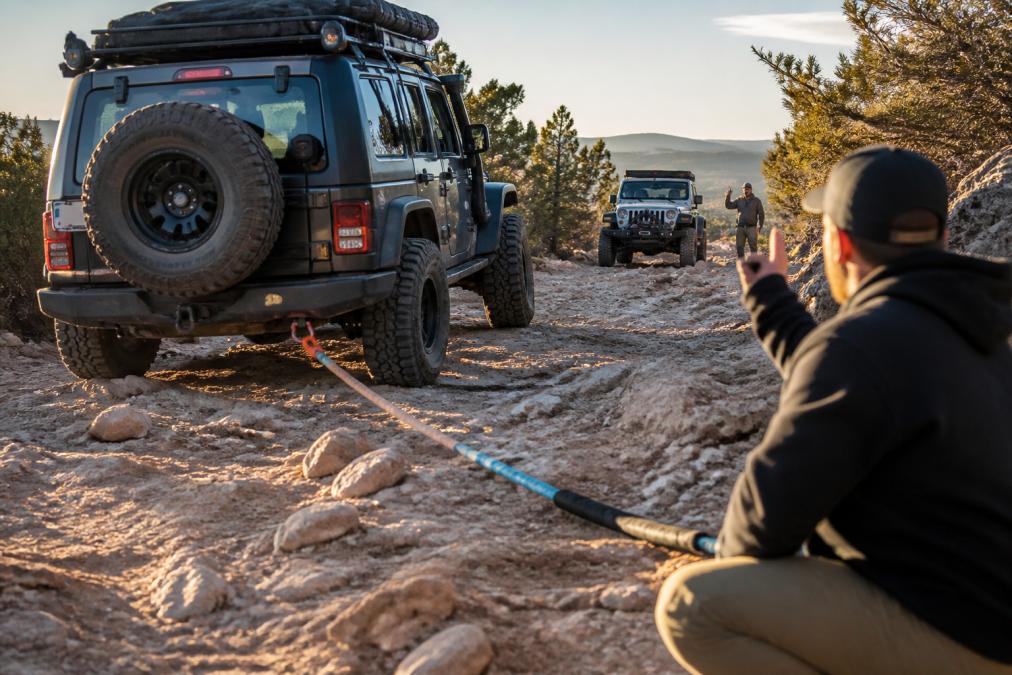
:::takeaway Before you pull, everyone involved must know their role. The spotter controls the operation, the driver only acts on clear signals, and no one stands in the path of the rope or near the recovery points. This discipline prevents the majority of recovery-related injuries.
Post-Recovery Gear Maintenance and Trail Etiquette
The recovery is done, but your responsibility is not. Post-recovery gear maintenance is essential for ensuring your equipment is ready for the next trip. After every recovery, clean your kinetic rope and straps with mild soap and water to remove mud, dirt, and debris that can abrade the fibers. Store them dry, out of direct sunlight, in a breathable bag, as UV radiation is one of the primary causes of synthetic rope degradation.
You also need to inspect your shackles for galling, bending, or cracks. Soft shackles should be checked for cuts in the Dyneema or other synthetic material. Winch cable or rope should be re-spooled under tension to ensure even layering on the drum. Trail etiquette demands that you leave your recovery site in better condition than you found it. This means not breaking tree branches for anchors, not leaving tire ruts that cause erosion, and not damaging vegetation. The Leave No Trace Center for Outdoor Ethics provides standards for minimizing your impact, which apply directly to how and where you perform recoveries.
Build Your Recovery Skills and Kit with Confidence
Recovery gear safety is a skill that improves with practice and honest assessment of your capabilities. The most reliable way to avoid a dangerous recovery is to prevent getting stuck in the first place, but when you do need to pull someone out, a methodical approach always wins over brute force. Consider your vehicle's weight, the terrain, and the condition of your gear before you commit to a pull. If you feel fatigued or uncertain, stop and reassess.
The Psychology of a Safe Recovery: Managing the Rush
The most dangerous element in any recovery isn't the rope, the winch, or the anchor, it's the human brain under stress. When you're stuck on a trail as the sun is setting, or you're holding up a group of friends in freezing weather, the psychological pressure to "just get it done" intensifies. This "rush to recover" mentality leads to skipped inspections, improper rigging, and people standing in the danger zone.
Experienced recovery leaders recognize this as a form of decision fatigue. After hours of driving, navigating obstacles, and managing the stress of being stuck, your cognitive resources are depleted, and you're more likely to take shortcuts. The solution is to institute a mandatory pause. When you arrive at a recovery scenario, take a deliberate 60-second timeout. Step away from the vehicles, take a few deep breaths, and walk the full perimeter of the recovery area to force your brain to shift from reactive mode to analytical mode.
The 10-Minute Rule
A common pattern among experienced off-roaders is the "10-minute rule." If a recovery attempt fails, or if you find yourself getting frustrated or impatient, you must stop all operations for a full 10 minutes. Use this time to re-assess the situation from scratch, check the gear for any signs of stress, and discuss alternative strategies with your team. This prevents the dangerous cycle of repeated, increasingly aggressive pulls that often leads to equipment failure.
Building a Pre-Recovery Checklist
To combat decision fatigue, create a simple, repeatable pre-recovery checklist that you run through every single time, without exception. This offloads the cognitive burden from your brain to a piece of paper or a mental routine. A basic version includes:
- Assess: Is the vehicle on stable ground? What is the pull angle?
- Inspect: Are all straps, ropes, and shackles free of damage?
- Verify: Are the recovery points rated and securely attached?
- Position: Is the dampener correctly placed? Is everyone clear of the danger zone?
- Communicate: Does everyone know the hand signals and their role?
By automating these checks, you reduce the chance of missing a critical step when your mind is tired, the same principle used in aviation and professional motorsports.
When to Walk Away
The most courageous decision you can make in a recovery is to stop. If the situation is beyond your skill level, if the gear isn't rated for the load, or if the anchor points are questionable, the safest option is to leave the vehicle and return with better equipment or professional help. This is not a failure; it's a calculated risk assessment. The cost of a tow truck or a professional recovery service is always less than the cost of a hospital visit or a destroyed vehicle. At OverlandRetail.com, we build our curated selection of recovery kits and off-road gear around the principle that reliability is non-negotiable. From kinetic recovery ropes and soft shackles to precision tire deflators that help you manage traction, our products are chosen for their durability and field-tested performance. When you gear up with us, you are investing in equipment built to withstand serious conditions, backed by free shipping and returns so you can get the right setup without risk.
Safe recovery is about respecting the forces involved and preparing for the unexpected. It requires the right gear, the right technique, and the right mindset. OverlandRetail.com helps you build that foundation with durable recovery kits and accessories that perform when you are miles from help. Explore our collection of recovery gear and vehicle accessories to ensure your next expedition ends with a story, not a recovery bill.
Frequently Asked Questions
What is the difference between a snatch strap and a tow strap?
A snatch strap, or kinetic recovery rope, is designed to stretch and store energy, allowing it to 'snatch' a stuck vehicle free with momentum. A static tow strap has minimal stretch and is meant for pulling a vehicle on a flat surface, not for extracting it from deep mud or sand. Using a static strap for a dynamic recovery can cause dangerous shock loads and component failure.
How often should you inspect your recovery gear for wear and tear?
Inspect your recovery gear before every trip and after each significant recovery. Look for frayed fibers, cuts, abrasions, broken stitching, rust, or deformation on metal parts like shackles and winch hooks. Any gear showing signs of damage should be retired immediately, as its working load limit is no longer guaranteed. Proper storage away from sunlight and moisture will extend its lifespan.
What are the safety risks of using a hitch ball for vehicle recovery?
Using a hitch ball for recovery is extremely dangerous. The ball is only designed to hold a trailer tongue weight, not the massive lateral forces of a vehicle recovery. Under load, the ball can snap off and act as a lethal projectile, traveling through the cab or striking bystanders. Always use a rated recovery point that is bolted directly to the vehicle's frame.