
How to Choose the Best Sleeping Pad for Overland Truck Builds

Last Updated: November 2, 2026
Quick Summary
Choose the best sleeping pad for overland truck builds by measuring the width between your wheel wells first, then matching pad type and size to that space. Two single pads of about 25 inches each beat one double pad, and an insulated inflatable with a closed-cell foam layer below handles cold nights.
- Measure truck bed width at the narrowest point between the wheel wells, not the tailgate opening.
- Two 25-inch pads need about 50 inches of clear width, so check your wheel well measurement first.
- Inflatable pads pack smallest but carry the highest puncture risk on a plywood deck.
- Layer closed-cell foam under an inflatable pad for winter insulation and abrasion protection.
- Build the platform to the pad, sealing the deck and adding a non-slip liner.
Table of Contents
- Why Your Sleeping Pad Decides How Well You Sleep in the Truck
- Measuring Your Truck Bed Before You Buy
- Inflatable, Self-Inflating, Foam, and Memory Foam Compared
- The Best Truck Camping Mattress Setup for Two Sleepers
- Sleeping Pad R-Value for Cold Weather Overlanding
- When a Self-Inflating Sleeping Pad for Truck Camping Makes Sense
- Building a Truck Bed Sleeping Platform That Fits Your Pad
- Durability, Repair, and What to Check Before You Buy
- Frequently Asked Questions
Why Your Sleeping Pad Decides How Well You Sleep in the Truck
A sleeping pad is the single piece of gear you will use every night of a trip, and it is the one most overlanders buy last. That order is backwards.
Truck beds are not flat rectangles. Wheel wells cut in from both sides, the tailgate adds length you can only use when it is down, and a mid-rise cap changes how much headroom you have above the pad. Get those numbers wrong and a premium pad becomes an expensive annoyance.
Below, we break down pad types, thickness, R-value, and platform fit so you buy once and sleep well for years.
Pad, Mattress, or Platform: What Goes Where
Three layers make up a truck sleep system, and each solves a different problem.
- The platform is the rigid base. It levels the floor over wheel wells and creates storage underneath.
- The mattress or pad is the comfort and insulation layer that sits on top.
- The bedding is what you actually touch: sheets, a quilt, a pillow.
A common mistake is buying a thick mattress first and building the platform around it. Measure and build the base first, then choose a pad that fits the space that is left. If you want to see how the pad fits into a full kit, our essential overlanding gear checklist lays out the rest of the setup in order.
Measuring Your Truck Bed Before You Buy
Measure your truck bed at the narrowest point, not the widest. Most buyers measure the tailgate opening, order a pad that matches, and then discover it will not sit flat between the wheel wells. This is the single most common fit mistake in truck sleep builds, and it is avoidable with a tape measure and ten minutes.
Take five numbers and write them down:
- Width between the wheel wells at floor level. This is your true width limit.
- Length with the tailgate closed, then again with it down.
- Height from floor to cap or cover, so you know how much pad thickness fits before you are touching the roof.
- Platform height, if you are building one, because the deck sits above the floor and reduces headroom by that amount.
- Any obstructions: tie-downs, bed rails, a spare tire mount, a sliding tray.
Working Through Common Configurations
Mid-size trucks often have tighter wheel well spacing. A common pattern is a gap between the wheel wells in the low 40-inch range, which is narrower than most two-person pads.
Measure the width between your wheel wells, since clearance varies by truck. Measure anyway, because bed length options and wheel well placement vary by cab and bed configuration.
Length is the easier number, but account for the platform. If your deck is framed above the floor, the usable length is the deck length, not the bed length. Leave a small margin at each end so the pad does not rub against the cap or tailgate.
Wheel Wells, Tailgates, and Real Usable Length
Wheel wells are the number that ruins most first purchases.
Tailgate length counts only if you sleep with it down, and only if your cap or cover allows it. Sleeping with the tailgate down in cold weather loses heat fast and exposes you to rain.
Watch out: measuring the tailgate opening instead of the wheel well gap is the classic error, and it produces a pad that bows up in the middle and sleeps worse than a thinner pad that fits.
Inflatable, Self-Inflating, Foam, and Memory Foam Compared
Most roundups list pad types and stop there.
Here is how the four types stack up against those criteria.
| Type | Packed Size | Comfort | Cold Weather | Puncture Risk | Setup Time | Best For |
|---|---|---|---|---|---|---|
| Inflatable | Smallest | Firmness adjustable | Needs insulation; pair with a foam layer below R-3 | Highest | 1-3 minutes | Tight cabs and small beds where storage is limited |
| Self-inflating | Medium | Stable, supportive | Good when the foam core is thick | Moderate | Seconds to unroll, top off with a few breaths | All-round truck camping and sleepers who move at night |
| Closed-cell foam | Bulky | Firm | Excellent | None | Instant | Backup layer, winter base under an air pad |
| Memory foam | Largest | Best pressure relief | Warm | Low, but tears at seams | Minutes to unroll and let expand | Fixed platforms and two-sleeper builds that stay in the truck |
Inflatable pads pack smallest and let you tune firmness, which matters when two sleepers share a platform and want different feels. The trade-off is that they are the least forgiving of a puncture and the coldest if you skip insulation. On a plywood deck, grit and screw heads are the usual culprits, so a thin closed-cell layer underneath is cheap insurance.
Self-inflating pads combine open-cell foam with air, so they are more stable and harder to bottom out.
Closed-cell foam is bombproof and cheap but bulky.
Memory foam is the most comfortable for side sleepers and the warmest, but it is the heaviest and bulkiest to store and does not compress well for travel.
A practical way to decide: if storage is tight, start with an insulated inflatable and add a closed-cell layer for cold trips. If setup speed and puncture resistance matter more than packed size, go self-inflating.
Big Agnes Rapide SL Insulated Sleeping Pad, Wide Regular →
For an insulated inflatable option, the Big Agnes Rapide SL Insulated Sleeping Pad is a three-season pad with a quilted top, 3.5 inches of loft, and an R-value up to 4.8 in a 25" x 72" wide regular size.

The Best Truck Camping Mattress Setup for Two Sleepers
Two single pads beat one double pad in almost every truck build. Each sleeper moves independently, so one person rolling over does not bounce the other awake. Singles also fit between wheel wells where a double will not.
Look for pads with side connection buttons if you want them to stay together. Pair them with a shared quilt rather than two separate bags, and use fitted sheets or a mattress strap to stop sliding on a smooth platform.
For a two-person setup, plan on two pads at roughly 25 inches wide each, which needs about 50 inches of clear width. Check that against your wheel well measurement before you commit.
Sleeping Pad R-Value for Cold Weather Overlanding
R-value measures resistance to heat loss, and it is the number that decides whether you sleep warm. A higher R-value means more insulation between you and cold air moving under the truck.
General guidance many campers use:
- R-value 1-2: summer and mild weather only
- R-value 3-4: three-season use, handles cold nights
- R-value 5 and up: winter and hard freezes
Cold air under a truck bed pulls heat out of a pad fast. If you camp in freezing conditions, layer a closed-cell foam pad under your inflatable pad. The foam adds insulation and protects the air pad from abrasion on the platform. For more on layering and cold-weather gear, see the reliable camping gear checklist.
When a Self-Inflating Sleeping Pad for Truck Camping Makes Sense
A self-inflating sleeping pad for truck camping is the right call when you want setup to take seconds and you do not want to worry about punctures. Open-cell foam inside the pad gives it structure, so it will not deflate into a puddle if it gets a slow leak.
These pads suit:
- Sleepers who move a lot at night and bottom out thin air pads
- Builds where the pad stays in the truck and only gets unrolled at camp
- Anyone who wants a backup that works even if the valve fails
The trade-off is packed size and weight. If your platform has fixed storage underneath, that rarely matters. If you are pulling the pad in and out of a 4Runner every morning, it does. Our self-inflating sleeping pad with seat cushion is one option to consider if you want to test this type.

Building a Truck Bed Sleeping Platform That Fits Your Pad
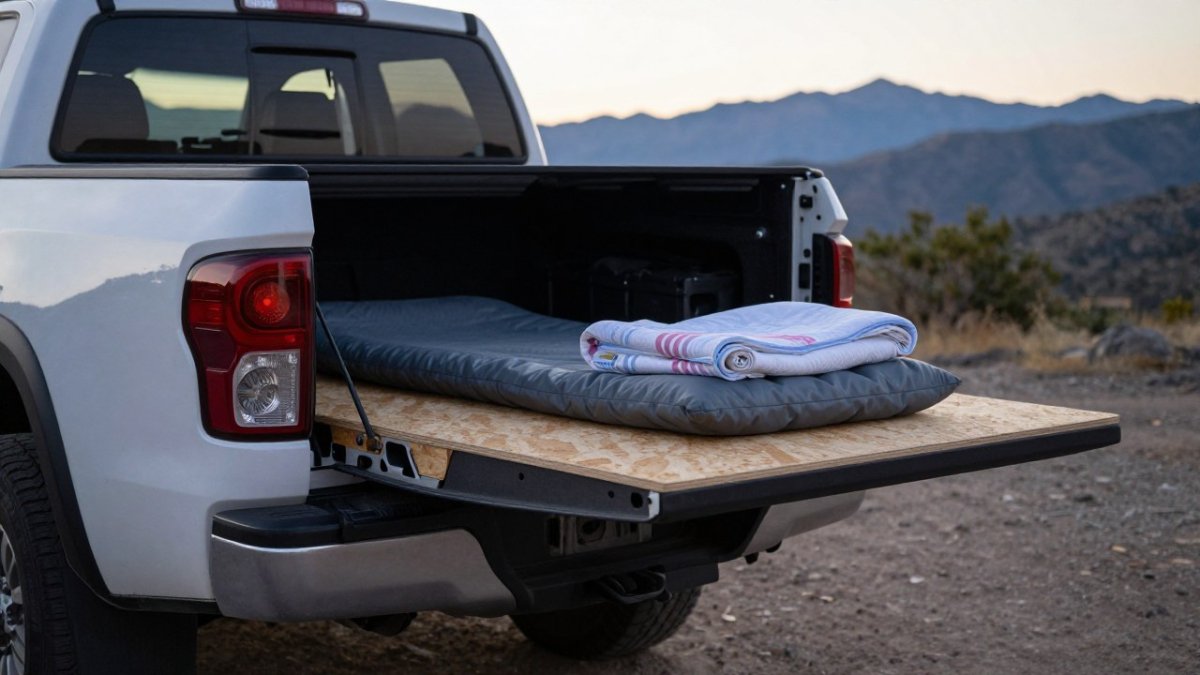
Build the platform to the pad, not the other way around. Cut the deck to your measured width between wheel wells, then leave a small margin so the pad does not rub against the sides.
A simple build works well:
- Cut a plywood deck to your measured width and length.
- Frame it with lumber so the deck sits level above the wheel wells.
- Add vertical dividers to create storage bays underneath.
- Seal the deck with paint or a waterproof coating.
- Add a non-slip liner so the pad stays put on corners.
Watch out: skipping the waterproof coating lets condensation and spilled water soak the plywood, and a soft deck will sag under a heavy two-person setup within a season.
Durability, Repair, and What to Check Before You Buy
Check three things before you pay: the valve, the shell fabric, and the warranty. Valves are a common failure point on inflatable pads, so look for a high-volume valve you can micro-adjust. Shell fabric should be ripstop nylon or a coated polyester with welded seams rather than glued ones.
Carry a repair kit every trip. Before you buy, confirm the pad comes with a repair kit and that the maker guarantees against manufacturing defects.
For a full pre-trip gear audit, work through our overlanding gear checklist alongside your pad purchase.
Frequently Asked Questions
What size sleeping pad fits a truck bed?
Measure the usable length between the closed tailgate and the front of the bed, then subtract a few inches for bedding and window clearance. A wide regular pad at 25 by 72 inches fits most mid-size and full-size beds with room to spare. Check the width between the wheel wells too, since that is the real limit for a two-person setup. If your bed is shorter than 72 inches, look at a 66-inch pad or build a platform that extends over the tailgate.
What R-value sleeping pad do I need for cold-weather overlanding?
For three-season trips down to around freezing, an R-value of 4 to 5 is a sensible baseline. Below freezing, look for 5 or higher, and pair an insulated inflatable pad with a closed-cell foam layer underneath for extra protection from cold truck-bed surfaces. Summer trips in mild weather can get away with 2 to 3.
Are self-inflating or air sleeping pads better for truck camping?
Self-inflating pads are simpler: they inflate in about 30 to 60 seconds with a built-in pump, resist sliding, and handle rough truck-bed surfaces well. Air pads pack smaller and let you fine-tune firmness, which matters if you sleep on your side.
Can you use a regular camping sleeping pad in a truck bed?
Yes, and most overlanders do. The main adjustments are fit and surface protection. A standard 72-inch pad works in most beds, but you may need to angle it around wheel wells or add a platform for a flat base. Put a waterproof layer under the pad to guard against grit and condensation, and use a window shade or cap to cut drafts. A regular pad paired with a proper platform sleeps close to a purpose-built truck mattress.
The hard part is not picking a pad. It is measuring your bed honestly, matching the pad type to how you actually camp, and building a base that fits. OverlandRetail.com stocks gear built for the road less traveled, with free shipping and returns, so you can test a pad on a real trip and send it back if it does not work. Start with our insulated inflatable pads and self-inflating options, and get the sleep sorted before your next departure.
