
How to Choose Portable Water Filtration for Overlanding in 2026

Last Updated: November 5, 2026
Quick Summary
Portable water filtration for overlanding means treating surface water from lakes, rivers, and streams so it becomes safe drinking water on multi-day vehicle trips. Choose a filter with an absolute pore size stated, such as 0.1 micron, and match its capacity and flow rate to your daily consumption rather than your trip length.
- A filter strains contaminants out of water; a purifier also neutralizes viruses, which are too small for most filter pores.
- Plan capacity around daily consumption: two people drinking four liters and cooking with one need ten liters daily.
- Backflush at the end of each day's use with clean treated water, not raw source water.
- Standard filters do not remove dissolved chemicals, fuel, or heavy metals; activated carbon adsorbs many organics and improves taste.
- Store filters inside the vehicle cabin in winter and retire any filter that freezes.
Table of Contents
- Why Portable Water Filtration Matters on the Trail
- Portable Water Purifier for Camping: Filters vs Purifiers
- Best Portable Water Filter for Travel: Selection Criteria
- Water Filter Capacity and Flow Rate Explained
- Water Filter Maintenance and Backflushing
- Chemical, Fuel, and Heavy-Metal Contamination: What Filters Miss
- Cold-Weather Use, Freeze Damage, and Trip-Level Water Planning
- Build Your Overland Water Kit at OverlandRetail.com
- Frequently Asked Questions
Why Portable Water Filtration Matters on the Trail
Portable water filtration for overlanding is the practice of treating surface water from lakes, rivers, and streams so it becomes safe drinking water on multi-day vehicle trips. It matters because remote routes rarely offer reliable potable water, and carrying every gallon you need adds weight and consumes storage space.
The answer starts with a mental shift. Treat your water supply as a system with two parts: what you carry and what you can produce. Carrying capacity gets you through the first day or two. Filtration capacity keeps you going for the rest of the trip. Overlanders who plan only for storage end up rationing.
A common mistake is buying a filter as an afterthought, the week before departure. If you want to see how water treatment fits into a complete setup, our reliable camping gear checklist and essential overlanding gear checklist both map out where filtration belongs in your load plan.
Portable Water Purifier for Camping: Filters vs Purifiers
A filter physically strains contaminants out of water; a purifier does that plus neutralizes viruses, which are too small for most filter pores to catch. That difference decides which device suits your terrain. In backcountry settings with low human waste risk, a filter is usually enough. Traveling internationally or drawing from water near heavy human activity, a purifier is the safer choice.
The terms get used loosely in product listings, which confuses buyers. Check the specification label, not the marketing name. If a device claims virus reduction, it is acting as a purifier, typically through a combination of filtration and chemical or electrostatic treatment.
What Each Removes: Bacteria, Protozoa, Viruses, Microplastics
Bacteria and protozoa are the primary targets for most overlanding scenarios. Giardia and Cryptosporidium are the protozoa that most often cause trouble for campers drawing from surface water. Microplastics are a newer concern, and absolute-rated hollow fiber membranes capture them well.
Viruses are the gap. Most pump filters and squeeze filters do not remove them at all. If your route crosses agricultural runoff, popular dispersed camping areas, or international borders, add a purification step rather than relying on filtration alone.
Best Portable Water Filter for Travel: Selection Criteria
The best portable water filter for travel balances four things: what it removes, how fast it flows, how much it weighs, and how long it lasts. Get those four right for your trip profile and the brand choice becomes easy. Get them wrong and you will be fighting your gear at camp every evening.
Here is how we would score a candidate before buying:
- Removal rating: absolute pore size stated, not "nominal." A 0.1 micron absolute rating blocks bacteria and protozoa.
- Flow rate: how long to fill a one-liter bottle. Under a minute is comfortable; over three minutes gets old fast.
- Weight and packed size: matters most if you also carry a backup.
- Cartridge life: gallons or liters rated, and whether replacement cartridges are available.
- Backflushable: can you restore flow in the field without tools?
- Field serviceability: can you clean it with what you already carry?
Vehicle Installation and Power Requirements
This is where overlanding diverges from backpacking, and where most buying guides stop short. Vehicle-based travelers can use larger systems such as inline filters, gravity-fed bags, or 12-volt pump systems.
Match the power draw to your electrical setup. A small 12-volt pump pulls modest current and runs fine from a cigarette socket; larger systems want a dedicated circuit. Gravity and squeeze systems need no power at all, which makes them the sensible backup when your battery is already committed to a fridge.
Water Filter Capacity and Flow Rate Explained
Capacity is how much water a filter treats before the cartridge needs replacement; flow rate is how quickly it treats each batch. These trade off against each other.
Plan capacity around your daily consumption, not the trip length. If two people drink roughly four liters a day and cook with another liter, that is ten liters daily.
Flow rate matters most when you are thirsty and tired. Squeeze filters are quick for one or two bottles. Gravity systems suit filling multiple bottles or a storage container at camp while you set up.
Sediment is the silent killer of flow rate. Pre-filter cloudy water through a cloth before it hits the cartridge, and you will get far more usable life out of it.
Capacity and flow rate pull against each other, so plan both around your daily consumption rather than trip length.
| Item | Value | Note |
|---|---|---|
| Daily consumption example | Two people drink four liters, cook with one | Ten liters daily |
| Filter rated for hundreds of liters | Covers a long trip comfortably | , |
| Filter rated for a few dozen liters | Does not cover a long trip | Cartridges bought mid-route |
| Squeeze filters | Quick for one or two bottles | , |
| Gravity systems | Fill multiple bottles or a storage container | Suits camp setup time |
| Pump filters | Middle ground on speed | Control over source-water pressure |
| Sediment | Silent killer of flow rate | Pre-filter cloudy water through a cloth |
Water Filter Maintenance and Backflushing
Backflushing is reversing water flow through the filter to push trapped sediment and organisms off the membrane, restoring most of the original flow rate. Do it regularly, not just when the filter clogs.
Sawyer Mini Water Filters (4-Pack) →
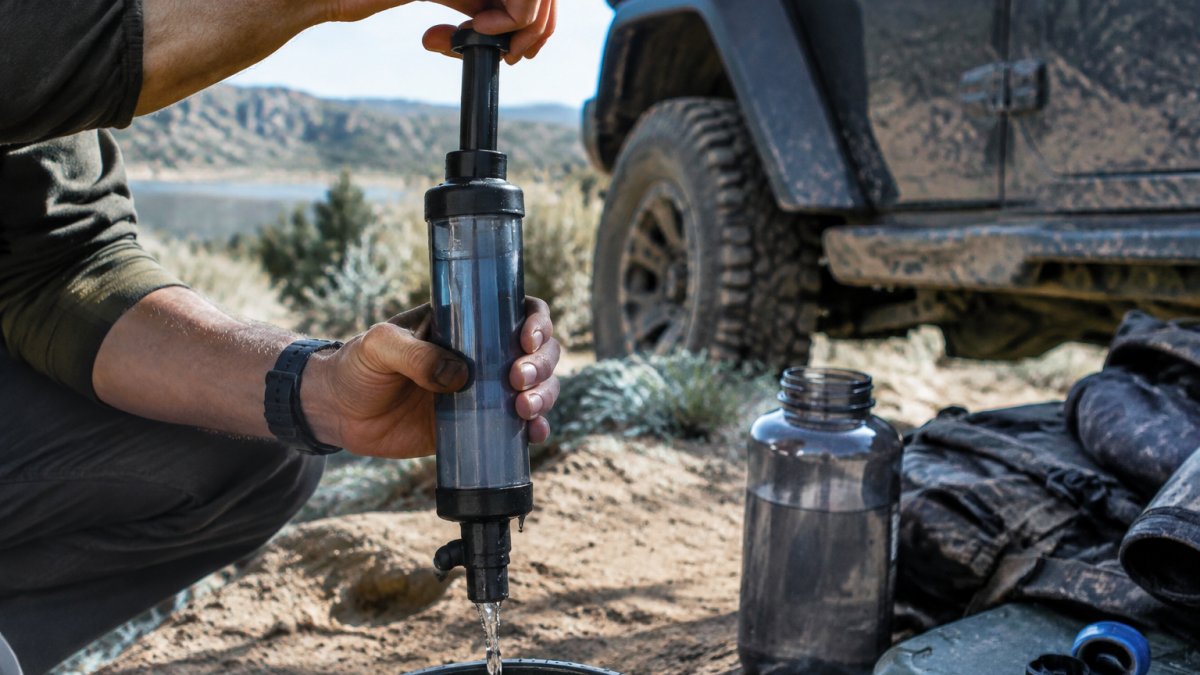
Our field routine is simple. Backflush at the end of each day's use, using clean treated water rather than raw source water. Shake out excess moisture and let the filter air-dry before packing.
Watch out: backflushing with dirty water pushes contaminants deeper into the membrane instead of clearing them. Use the cleanest water you have.
Integrity testing matters too. If a filter has been dropped, frozen, or handled roughly, check it before trusting it. Many manufacturers publish a simple integrity check.
Chemical, Fuel, and Heavy-Metal Contamination: What Filters Miss
Standard filters do not remove dissolved chemicals, fuel, or heavy metals. Pore-based filtration catches particles, and dissolved contaminants pass straight through.
It helps to separate what a filter can and cannot do by contaminant class:
- Microbiological (bacteria, protozoa, viruses): handled by absolute-rated hollow fiber membranes down to about 0.1 micron for bacteria and protozoa; viruses need a purifier step such as chemical, electrostatic, or UV treatment.
- Sediment and microplastics: captured by the membrane and by any pre-filter; this is the easy part.
- Dissolved organics (fuel, solvents, some pesticides): pass through a pore filter untouched. Activated carbon adsorbs many of these and improves taste, but carbon has finite capacity and must be replaced on schedule, not just when taste changes.
- Heavy metals (lead, arsenic, mercury, cadmium): pass through pore filters and are only partly addressed by standard carbon. Treatment rated specifically for heavy metals, such as certain carbon blocks or ion-exchange media, is required.
- Nitrates and agricultural runoff: common in farming areas and not removed by pore filtration; reverse osmosis or specific ion-exchange treatment is the reliable route, and neither is typical of portable overlanding gear.
- Salts and dissolved solids (brackish or coastal sources): only reverse osmosis removes these at the portable scale; most overlanding filters will not make brackish water drinkable.
If you suspect chemical contamination, filtration alone is not enough. Activated carbon reduces many organic chemicals and improves taste, and some systems combine carbon with the membrane.
Practical rule: never draw drinking water downstream of a fuel spill, a mining operation, or heavy agricultural activity. Move upstream or find another source. No portable device substitutes for choosing a clean source, and source selection is the cheapest treatment step you have.
Watch out: a carbon stage that has been sitting wet and warm between trips can grow odor and lose adsorption capacity; replace it on the manufacturer's interval rather than trusting a taste test.
Cold-Weather Use, Freeze Damage, and Trip-Level Water Planning
Freezing can damage a filter. Water expands inside the membrane, and the resulting micro-cracks can impair it. A filter that froze overnight may still pass water while no longer removing contaminants reliably.
Store filters inside the vehicle cabin in winter, not in an exterior compartment or roof box. Drain them fully before cold nights. If a filter does freeze, retire it.
Trip-level planning ties everything together. Before departure, map your water sources along the route and note where refills are possible. Carry a primary filter, a backup method, and enough storage to bridge the longest gap between sources. Emergency backup deserves real thought: a squeeze filter packed as a spare weighs almost nothing and works when a pump fails.
The Sawyer Mini Water Filters 4-pack uses a 0.1 micron absolute hollow fiber membrane, removes bacteria, protozoa, and microplastics, and can be backflushed to restore flow.

Build Your Overland Water Kit at OverlandRetail.com
Building a water kit is a series of small decisions that compound: which filter, what backup, how much storage, where it all lives in the vehicle. Get those right and water stops being a planning worry on every trip.
We offer gear for this kind of travel, with free shipping and returns. If you are ready to add filtration to your setup, shop the Sawyer Mini Water Filters 4-pack and see the specs for yourself.
Frequently Asked Questions
What is the difference between a water filter and a water purifier?
A filter physically blocks contaminants through a membrane, typically down to 0.1 microns, which removes bacteria, protozoa, and microplastics but not viruses. A purifier adds a treatment step such as UV light or chemicals to neutralize viruses, which matter more in water contaminated by human or animal waste. For backcountry surface water, a filter covers most needs. Carry a purifier or chemical backup if your route crosses farmland, popular campsites, or international sources where viral risk is higher.
How much water should you carry when overlanding?
Plan on roughly one gallon per person per day for drinking and cooking, plus extra for washing and pets. A two-person, three-day trip needs about 8 to 10 gallons total. Carry a mix of storage and treatment: filled containers for immediate use and a portable water filtration setup for refilling from streams, lakes, or campground taps. Keep at least one gallon per person as an untouched emergency reserve in case a water source is dry or unsafe.
Can a portable water filter remove viruses?
Most hollow-fiber and carbon-block filters do not remove viruses because virus particles are smaller than their pore sizes. The Sawyer Mini, for example, is rated at 0.1 micron absolute and removes 99.99999% of bacteria and 99.9999% of protozoa, but its listing does not claim virus removal. If your route includes water with human waste risk, pair the filter with a purifier, boil the water, or use chemical treatment as a second step.
How do you maintain a portable water filter on an overlanding trip?
Backflush the filter after each day of use with clean water using the supplied plunger or a backflush adapter, which restores flow and clears trapped sediment. Never let a hollow-fiber filter freeze, since ice crystals crack the membrane and ruin it permanently. Store it dry with the caps off between trips, and inspect the housing for cracks before each departure. A well-maintained Sawyer Mini can last up to 100,000 gallons with no cartridge replacement, so routine backflushing is the main maintenance task.
Your next trip will test your water plan whether you want it to or not. Start with a filter you trust, a backup that weighs nothing, and a storage plan sized to your longest gap between sources. OverlandRetail.com carries durable, high-quality overlanding gear with free shipping and returns, so you can equip your rig and travel with confidence. Get started with OverlandRetail.com and build a water kit that keeps you moving.
