
Is a Portable Air Compressor Worth It for Off-Road Use

Last Updated: November 4, 2026
Quick Summary
Yes, a portable air compressor is worth it if you air down your tires at all. Airing down softens the tire and widens the contact patch for sand, gravel, and rock, and the compressor lets you air back up to protect the sidewall and restore handling for the drive home. Skip it and you are stuck.
- A tire inflator is built for topping off a low tire, while a portable air compressor handles sustained, repeated fills.
- CFM is the spec that matters most for airing up four tires, since higher flow means faster inflation.
- Duty cycle is the percentage of time a compressor can run before it needs to cool down.
- A typical 33-inch off-road tire holds roughly 3 to 4 cubic feet of air at street pressure.
- A compressor refills a tire but cannot fix a puncture, so carry a tire plug kit too.
Table of Contents
- What a Portable Air Compressor Actually Does for a 4x4
- Portable Air Compressor vs. Tire Inflator: Which One You Need
- The Best Portable Air Compressor for Off-Road Tires: What to Look For
- Portable Air Compressor Duty Cycle Explained for Beginners
- Portable Air Compressor Tire Inflation Time: Real Numbers
- Power Source, Safety and Long-Term Reliability
- Pairing Your Compressor With OverlandRetail.com Air-Down Gear
- Frequently Asked Questions
What a Portable Air Compressor Actually Does for a 4x4
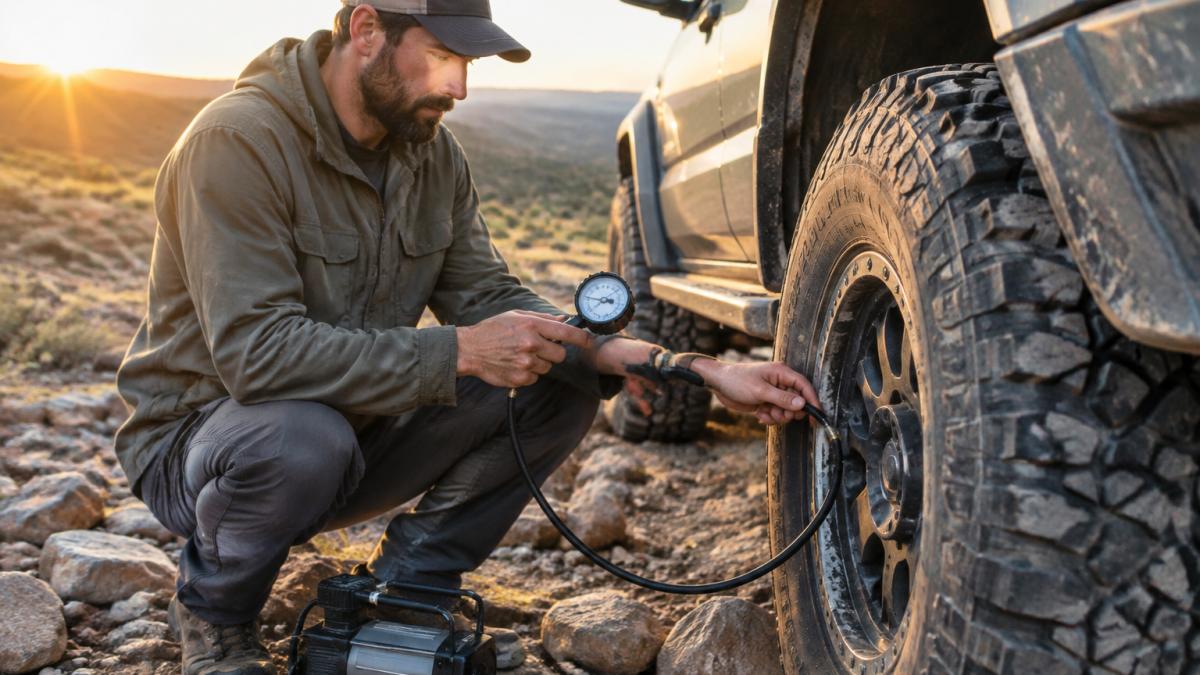
A portable air compressor is a compact, vehicle-powered pump that refills tires to a precise pressure without a shop visit. For off-road drivers, that single capability changes how a trail day works. You air down for traction, then air back up for the highway. Without a compressor, you either drive home on soft tires or hunt for a gas station.
A common question from new overlanders is whether a portable air compressor is worth it. The answer is yes, if you air down at all. The two habits go together. Airing down softens the tire, widens the contact patch, and helps you float over sand, gravel, and rock. Airing back up protects the sidewall and restores handling for the drive home.
The compressor is the second half of that routine. Skip it, and you are stuck.
If you want to see where the compressor fits in the bigger picture, our guide to essential 4x4 vehicle recovery tools lays out the full kit. The compressor sits near the top of that list, right beside a good deflator and a tire repair kit.
Portable Air Compressor vs. Tire Inflator: Which One You Need
A portable air compressor and a tire inflator are not the same tool, and the difference decides what you can do on the trail. A tire inflator is built for topping off a low tire. A portable air compressor is built to move real air volume, run longer, and handle repeated fills.
That distinction matters most when you air down all four tires and need to bring all four back up. A small inflator will get there, but slowly, and it may overheat before the job is done.
Where a Tire Inflator Stops and a Compressor Starts
A tire inflator is a lightweight pump designed for occasional top-offs, usually drawing power from a 12V power outlet. It works fine for a slow leak or a soft tire before a commute.
A portable air compressor is built for sustained work and repeated use.
The practical test is simple. If you plan to air down and air up every trip, buy a compressor. If you only want insurance against a slow leak, an inflator covers it.
The Best Portable Air Compressor for Off-Road Tires: What to Look For
Buy a portable air compressor for the work you actually do, not the biggest number on the box.
PSI, CFM and Tank Size in Plain Terms
Three specs decide how a compressor performs. Here is what each one means in practice.
Auto-Stop Tire Deflators, Adjustable 10-30 PSI (Set of 4) →
- PSI (pounds per square inch): the pressure it can produce. Most off-road tires need well under what a decent compressor can deliver, so PSI is rarely the limiting factor.
- CFM (cubic feet per minute): the air flow rate. Higher CFM means faster inflation. This is the number that matters most for airing up four tires.
- Tank capacity: stored air ready to go. A small tank smooths out the flow and helps with quick jobs. A tankless unit is lighter but relies fully on the pump.
| Spec | What It Controls | What to Prioritize |
|---|---|---|
| PSI | Maximum pressure | Enough to exceed your tire's target |
| CFM | Inflation speed | Higher is faster for four-tire fills |
| Tank capacity | Stored air buffer | Small tank for convenience, none for weight |
| Duty cycle | Run time before cooldown | Match to your tire size and count |
Portable Air Compressor Duty Cycle Explained for Beginners
Duty cycle is the percentage of time a compressor can run before it needs to cool down. A 50% duty cycle at 30 minutes means 30 minutes of pumping, then 30 minutes off. Beginners overlook this spec, and it is the one most likely to leave you waiting on the trail.
Watch out: ignoring duty cycle on a hot day is how pumps fail early. If your compressor shuts off mid-fill, let it cool fully before restarting. Forcing it back on shortens its life.
Portable Air Compressor Tire Inflation Time: Real Numbers
Inflation time depends on the air volume a tire needs and the compressor's CFM at working pressure. You can estimate the volume yourself: a typical 33-inch off-road tire holds roughly 3 to 4 cubic feet of air at street pressure, and a 35-inch tire holds a bit more. Going from 15 PSI back to 35 PSI means adding roughly two-thirds of that volume, so call it 2 to 2.5 cubic feet per tire, or 8 to 10 cubic feet for all four.
Power Source, Safety and Long-Term Reliability
A tire plug kit belongs in the same bag. A compressor refills a tire, but it cannot fix a puncture. Our heavy-duty tire plug kit with MOLLE pouch handles tubeless punctures on the trail, and it mounts right to your rig. For safety habits that pair with your compressor setup, read our offroad recovery gear safety tips.

Pairing Your Compressor With OverlandRetail.com Air-Down Gear
A compressor only earns its keep when the air-down side of the routine is just as easy. That is where the right gear completes the kit. Set your target pressure, let the valves do the work, then refill with the compressor when you are ready to hit the highway.
Our auto-stop tire deflators, adjustable 10-30 PSI air down all four tires. Each valve stops on its own when it reaches your pre-set PSI. The set is adjustable without tools and comes with a 2-year warranty.

Best for: drivers who air down regularly and want a repeatable routine. Skip if: you never leave pavement and only need occasional top-offs.
Frequently Asked Questions
Do portable air compressors really work for airing up off-road tires?
Yes, a portable air compressor can air up off-road tires. Check the CFM rating at your target pressure before buying, not just the peak number on the box.
Should I buy a tire inflator or a portable air compressor?
The portable air compressor vs. tire inflator choice comes down to volume. If you only drive paved roads, an inflator may be enough. If you air down regularly, a portable air compressor is the more practical choice.
How long does a portable air compressor take to inflate a tire?
Portable air compressor tire inflation time depends on tire size, the pressure gap and the compressor's CFM at working pressure. Always start with the engine running so you are not draining the battery.
Are portable air compressors reliable for roadside emergencies?
Keep any compressor clean and dry, check the hose and chuck for cracks, and test it at home before a trip.
What does portable air compressor duty cycle mean and why does it matter?
Duty cycle is the run time a compressor handles before it needs to cool. For four-tire air-ups, plan cooling breaks between tires if your unit needs them.
The trail rewards drivers who prepare, and tire pressure is where that preparation shows. Build the full routine, from deflators to compressor to plug kit, and you will spend less time managing tires and more time exploring. Get started with OverlandRetail.com and gear up for the road less traveled.
